





Rule 34 COLREG — Signals in Normal Visibility
The International Regulations for Preventing Collisions at Sea (COLREG), adopted on October 20, 1972, aim to ensure the safety of navigation, prevent collisions, and facilitate interaction between vessels. Specifically, Rule 34 of COLREG governs the use of maneuvering and warning signals, which are particularly crucial when vessels are in sight of one another.
These regulations were developed by the International Maritime Organization (IMO) to enhance the safety of navigation and prevent accidents at sea. To date, they have been ratified by many countries and are applied in both maritime and inland waters. The rules regulate crew actions, maneuvers, and the use of light and sound signals in various situations.
Rule 34 COLREG: Who Should Know and When Signals Are Used
Rule 34 COLREG provides clear guidelines for the use of maneuvering and warning signals. These signals are used by all vessels in sight of one another, from small yachts to large cargo ships.
Ship’s Horn: A Device for Sound Signals
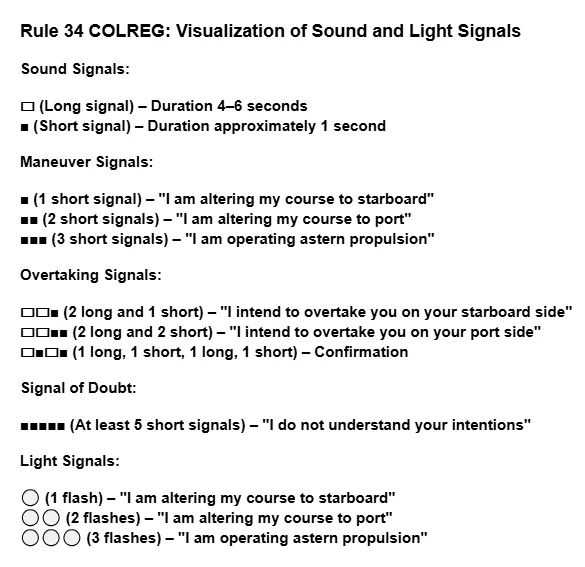
A ship’s horn is used to emit sound signals. This device produces a loud, low-frequency sound, similar to a prolonged blast, which effectively carries over long distances. According to COLREG, a short signal lasts about one second, while a long signal lasts between four and six seconds.
Maneuvering Signals
- One short blast: “I am altering my course to starboard.”
- Two short blasts: “I am altering my course to port.”
- Three short blasts: “I am operating astern propulsion.”
Light Signals
- One flash: “I am altering my course to starboard.”
- Two flashes: “I am altering my course to port.”
- Three flashes: “I am operating astern propulsion.”
Each flash should last about one second, with an interval of approximately one second between flashes. The minimum interval between signal sequences is ten seconds. A white all-round light (commonly a lantern) visible from at least 5 miles is used for these signals.
Rule 34 COLREG: Signals During Overtaking
A vessel intending to overtake another shall signal:
- Two prolonged blasts and one short blast: “I intend to overtake you on your starboard side.”
- Two prolonged blasts and two short blasts: “I intend to overtake you on your port side.”
The overtaken vessel confirms agreement with the signal: One prolonged blast, one short blast, one prolonged blast, and one short blast.
Signal of Doubt
If a vessel does not understand the intentions of another or doubts that sufficient measures are being taken to avoid collision, it must sound at least five short and rapid blasts. This signal may be supplemented by the same number of flashes.
Signal When Approaching a Bend or Obstruction
When approaching a bend in a channel or an area with restricted visibility, a vessel shall sound one prolonged blast. This warning must be acknowledged by an approaching vessel with the same signal.
Limitations for Vessels with Multiple Ship’s Horns
If a vessel is equipped with multiple horns located more than 100 meters apart, only one horn should be used for signaling.
Conclusion
Modern navigation technologies have significantly simplified vessel operation. However, knowledge of sound and light signal rules remains a critical skill for preventing accidents. It is also essential to consider Rule 35 of COLREG, which describes signals in restricted visibility. We will cover this in more detail in the next article.